Showing posts with label China. Show all posts

Thursday, 5 April 2012

Chinglish, The Broadway Musical - The Funny Truth

Chinglish
This is a long overdue post, as the play, Chinglish, has concluded its run, and I saw it back in November. It's still worth writing about, however, as there are so many things that people can learn from a production like this, and so much that is timeless. It was written ny David Henry Hwang and written by Leigh Silverman, and it's essentially a comedy about an American businessman's first China experience.

From the Chinglish Facebook Page
The great thing about this play is that it wasn't just entertaining, it brought out a lot of the finer details of Mainland Chinese culture (and issues arising from cultural differences) that outsiders simply would never even have guessed. The underhand dealings (that were in turn, underhanded) made for a great plot, and this was probably the most easily accepted/expected part of the story. There were other humorous scenes like when the male lead, Gary Wilmes, tries to say "I love you" in Mandarin and it comes out sounding completely wrong because of the tones etc. Predictable, but well done nonethless. Other parts, such as the ex-English teacher, posing as a business consultant, admitting his waning popularity and novelty to Chinese people, was very true, and probably a concept less familiar to most outside of China.


The one point that I can't get out of my head is how they totally nailed the traditional Chinese view of marriage. When Wilmes professes his love for Jennifer Lim, the female lead (pictured above in my crappy photo of the play's programme), and suggests they divorce their respective spouses to get married, Lim talks about qingyi 情義. She says that she doesn't love her husband, and actually scoffs at the idea, but she will never divorce him because of qingyi. This is a word that doesn't really have a direct English translation, perhaps because the idea doesn't exist culturally in the Anglo world (per the Sapir-Whorf hypothesis). The closest I can think of is loyalty, but it's more like loyalty, along with love, which doesn't have to be romantic at all. It's funny because in Hong Kong triad movies they talk about this yi all the time. People brought up the Chinese "way" generally know this and put it in practice (hello nepotism - well, that's the bad part anyway) but we hardly ever talk about it. This qingyi is also seen between the English teacher and the mayor, who ends up being taken in by authorities on accusations of corruption.

To me, the way that it was presented makes it a sort of wake-up call. Even though its main impact on Americans (I suppose) was that they got an "inside" look into what China is really like (and the play did a very good job of that), I believe the play was a rather introspective experience for anyone brought up immersed in Chinese culture and with some first-hand experience of the Mainland. It was very exciting to see that the writer's observations, experience and analysis of China were so real and detailed (or perhaps just similar to my own?), and that he brought them to life, and to a wider audience, on stage. I've spoken to many an outsider who thinks that if they understand guanxi they know all about business in China; Chinglish would have been a great, harmless way to tell them "yeah, right".

Saturday, 21 January 2012

Hongkongers are dogs; and some observations on Mainland Chinese and Hong Kong media

All over my Facebook News Feed tonight is this video of someone repeatedly saying "Hongkongers are dogs" and "Hongkongers are bastards".


This guy is supposed to be a professor from Peking University. I guess each part of the world has their fair share of barking academics, but China is probably the only place where someone like this wouldn't get fired.


If he has half a brain he'd know that by stirring this stuff up he'd get himself seen, read etc. all over the interwebs - and guess what, we all fell for it. (Fuelling the "us and them" mentality - how creative). Maybe it was the channel's idea. The broadcaster that aired it is V1, which I'd never heard of. A quick check told me that they're a "new media" company - the conspiracy theoriest in me thinks they're just looking for a way to boost their ratings and visibility in the crowded internet news market.

Anyway, the bottom video, "reported" in that highly sensationalised manner typical of Hong Kong news (now that is something to talk sh*t about) shows a Hong Kong man shouting at a Mainland Chinese family for eating on the MTR. The shouting is indeed very rude, but you'll notice that about a third of the way through, the man explains to the MTR staff that he had tried telling them to stop eating before he went bezerk. Now, whether that's true is up to your interpretation - but it's funny that that never even came up in the arguments. If anyone has a longer video to share, it would be great to get a backstory.

I hope this isn't China's way of getting back at us because of that survey data that came out the other day about Hongkongers not identifying themselves as being "Chinese".

The Year of the Dragon will be the 15th year Hong Kong's been handed back to China. That's 35 years till we're no longer "one country two systems". Mounting fear, tensions, uncertainties are not surprising, but not exactly the best kinds of things to ring in the new year with, hey?

Saturday, 3 December 2011

TEDxHong Kong 2011

"Eco-Warrior" Willie Smits on his DeforestAction project, using a combination of satellites and students to help track illegal deforestation activities in Borneo
TED has been around for more than twenty years, but it wasn't until the past two or so that I've occasionally been watching these videos about "Ideas Worth Spreading".

TED grew into TEDx, the 'x' denoting independently organised events that are intended to give a "TED-like experience", and since then, Hong Kong has seen all sorts of TEDx's, including TEDxWanchai, TEDxYouth@Hong Kong, TEDxVictoriaHarbour, several TEDxPearlRivers and another TEDxHong Kong last year.

The second TEDxHong Kong was held yesterday (Friday 2 Dec 2011) and was called "Forever 2011", which included speakers talking about such diverse topics as sustainability, human regenerative engineering, generational use of technology, Hongkong-ness, gender equality, child psychology, accounting (uhuh!) and cryonics.

I volunteered to live tweet for the organisers (using the @TEDxHongKong handle) for the afternoon/evening so I could go check it out, as I'd never been to a TED or TEDx event before.

The afternoon consisted of an ambitious programme of 15 speakers - Eric Schuldenfrei, Yat Siu, Douglas Young, Samantha Hung, John Hung, Katrien Jacobs, Mok Ho-Yan, Louise Porter, Ravi Mantha, Aubrey de Grey, Max More, Alex Backer, Gary Biddle, Willie Smits and Glenn Frommer.

I'm not going to summarise each one as my eyes are threatening to fall out like a couple of dry raisins, and plenty of others will be covering the event (21cb.net for one), so I'll just be totally unscientific about it and talk about a few that stood out for me (and so I'll remember what I want to read up on later...)

Dr. Louise Porter

The author of "Children are people too" discussed how we (laymen adults) generally view children - stubborn and disruptive on purpose etc. and says it's basically ageism. (If we applied those beliefs to different races, it would definitely be seen as racism, which she showed in sample sentences). One of her main points was that children, just like teens and adults, have needs that need to be met. Instead of using the hardline, reward-and-punishment approach to them, we should look at their behaviour - say, tantrums- as an expression of need, and treat it accordingly. If you, an adult, is unhappy about something, the last thing you want is to be put in a corner, or a chair facing a wall, right? Yet we do that to children in the name of discipline. When they do something good, we give them a reward - game time, candy - then children will be conditioned into doing things for an actual reward, rather than joy. Dr. Porter suggests we should genuinely celebrate achievements with children, through vernacular that we already know and use as adults - "congratulations", "I'm so proud of you".

On a personal level, I found this insight amazing, because my parents would never, ever, have said anything like that, and I sort of blame it on Asian culture. The Confucian ideas that imply or even encourage power struggles between parents and children. Children are always expected to be respectful - that wouldn't be a problem if parents (or older people in general) were also expected to reciprocate, regardless of age. Ageism, I would argue, it ingrained in Chinese or Confucian-influenced cultures. I'm curious as to how well Dr. Porter's views would sit with my parents and grandparents!

Dr. Aubrey de Grey


Dr. de Grey is Chief Science Officer of SENS Foundation, charity that "works to develop, promote and ensure widespread access to rejuvenation biotechnologies which comprehensively address the disabilities and diseases of aging". He is a biomedical gerontologist, gerontology being the study of aging (I don't think I'd even seen this word before this talk). His approach to aging is akin to engineering, he says, and in his presentation, he talked about how your body can be "maintained", like a car, and thus kept biologically young. This differs from geriatrics, as that treats the ailments that come with old age just like ailments of those who are younger, focusing on treating symptoms.

In his mile-a-minute speech, he cited stem cell research, for example, as a way of "regeneration" - replacing parts in your body, rejuvenating them, rather than let them degenerate as a result of the damages done by metabolism (like wear and tear), so that at the choronological age of 90, you might have the body of a 60-year-old.

Dr. de Grey mentioned some excuses that people would give him about why they couldn't accept this concept of regeneration; one of which was, "I won't be around long enough" for things to be invented/discovered to save each part of their body, and the response to that was simple - "do you have children?" then "do you want your children to live healthier?".

On the subject of "health", he also concluded that with regeneration, he only wants people to live healthier, and that longevity would simply be a nice side-effect.

Ravi Matha

The medical writer started by suggesting that the "human body is a pond", in which there's heaps of bacteria. He goes on to debunk myths about antibacterials, antibiotics etc. and questions why we spend so many resources on making 'sexy' antibiotics for treating symptoms and not spend more on finding out the root cause of illnesses. Incredibly entertaining, yet he uses his time to explain an astounding number of facts and figures. He proves that logic and skepticism doesn't have to sound radical or dry.

Katrien Jacobs


"People's Pornography" is the name of Jacobs's book, and that was the topic of her talk, which was about eroticism as activism, and how pornography in Mainland China is in fact a socio-political act against censorship and other social taboos. She gave various examples eg. DIY porn, the rise of VPN use because of Japanese porn star Sola Aoi's Twitter account, and of course Ai Wei Wei's "One Tiger, Eight Breasts" project that inspired some Chinese to courageously air their thoughts about censorship. And yes, as @crocophant duly noted, her PowerPoint contained porn.

Some great talks and topics, with ideas definitely worth spreading, or at least worth further reading. Speakers aside, the event itself was only okay. I want to say that everyone was really into the spirit of TED, with dreams, positive attitudes, no weird ulterior motives and so on, but that wasn't always the case. Oh, and the lack of WiFi, ticketing (HK$350 a ticket...) - here I go again, blah blah blah, who cares what I think. So, that's all from me, folks.

Friday, 6 May 2011

Good Blogs about Retail in China

Just a quick jot-down of China blogs I've added to my Google Reader for some time and that are consistently giving me good info on Mainland Chinese retail habits and products.

I'm not a marketer, but being in Hong Kong, we're increasingly affected on a day-to-day basis by Mainland consumption. These English-language blogs are a great window into the fascinating world of Chinese spending.


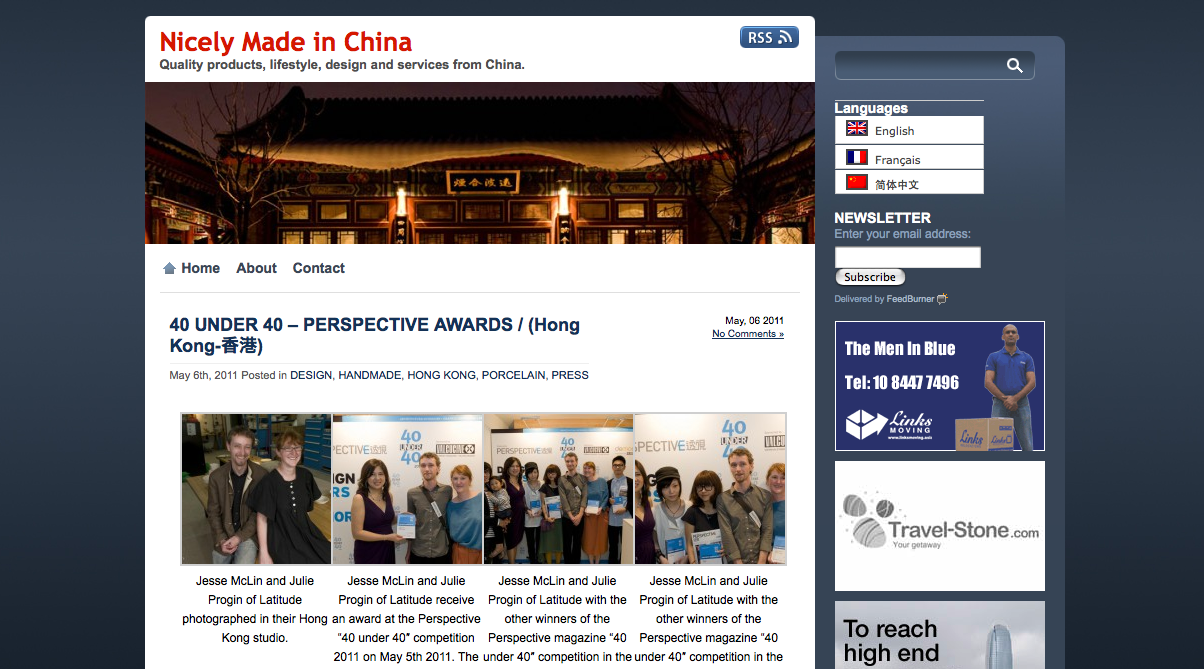
Nicely Made in China
Like it says on the tin. Things that are made in China, nicely. They exist (even though some are from Hong Kong, which doesn't usually suffer the same prejudice as "Made In China")


Red Luxury
Good tracker of (usually large, globally-recognised) luxury brands moving into China.


China Youthology
A brand consulting firm that focuses on youth marketing in China. Digging up some good stuff on grassroots trends and second- and third-tier youth sentiments hard for non-locals to pick up on. As anthropological as it is commercial.

As I said, these are just a few I found along the way. Would love to know more if you have any faves.

Edit 25/05/2011: adding as I go...


Jing Daily
Similar to Red Luxury, but probably broader in scope (Red Luxury is more luxury fashion). They go into art, wine, retail and finance with more of an industry-level approach and also create original content as opposed to aggregating as Red Luxury does.

Tuesday, 16 November 2010

Second-tier city virgin: Wuhan

Like many people who live outside Mainland China, I'd never been to a second-tier Chinese city. (There's no formal definition, but for a better idea, read an old article about it here). Wuhan, the capital of Hebei province in central China, is one such city.

Outside the Environment Preservation Office/Dept (or something to that effect). How far can you see?

These are sprawling metropolises like first-tier cities (Beijing, Shanghai) with most 'mod cons', skyscrapers and even a subway in the works, but the people are decidedly different. They've had very limited contact with the outside world. Foreigners are scarce, media and education talk about other countries like they're some alien planet that they'll never reach... Propaganda Committee messages are easily distributed in these parts. The most dangerous thing is, they're also becoming filthily rich (and that's not just because this is China's dustbowl). This means they'll make buying decisions on whatever info they can get, which are often half-truths or blatent fabrications. They'll believe stuff like - the air quality's bad because we had fireworks last week. Factories? Exhaust? Shenme? Just give me another ten of those Burberry trenches so I can keep the dust off my Zegna shirt, okay?
Pool by the lake

Most people are leisurely country folk making a living in the city, they don't go mile-a-minute like their first-tier counterparts. You'll see people playing majiang (or mahjong), cards, dancing in the park almost anytime of day. The pic is of some pool tables laid out next to one of the many city's lakes (nice, until you see the rubbish and oil bobbing about in them).

Chinese medicine, massage, fate and coffee. Something for everyone

For some reason there's also a slew of "coffee shops", which of course don't just sell (bad) coffee, some are massage parlours and majiang clubs too. I guess it says something about their laid-back mentality, and maybe a local legend who 'made it' by opening a chain of coffee shops all over the country?

This isn't exactly a coherent post, just some random thoughts on what it's like over there.

Friday, 4 June 2010

River crab (河蟹)

河蟹. 1. noun. Literally, river crab; 2. adj. Cantonese-derived pseudo-Mandarin for 和諧, adj. Harmonious, to be in concordance.

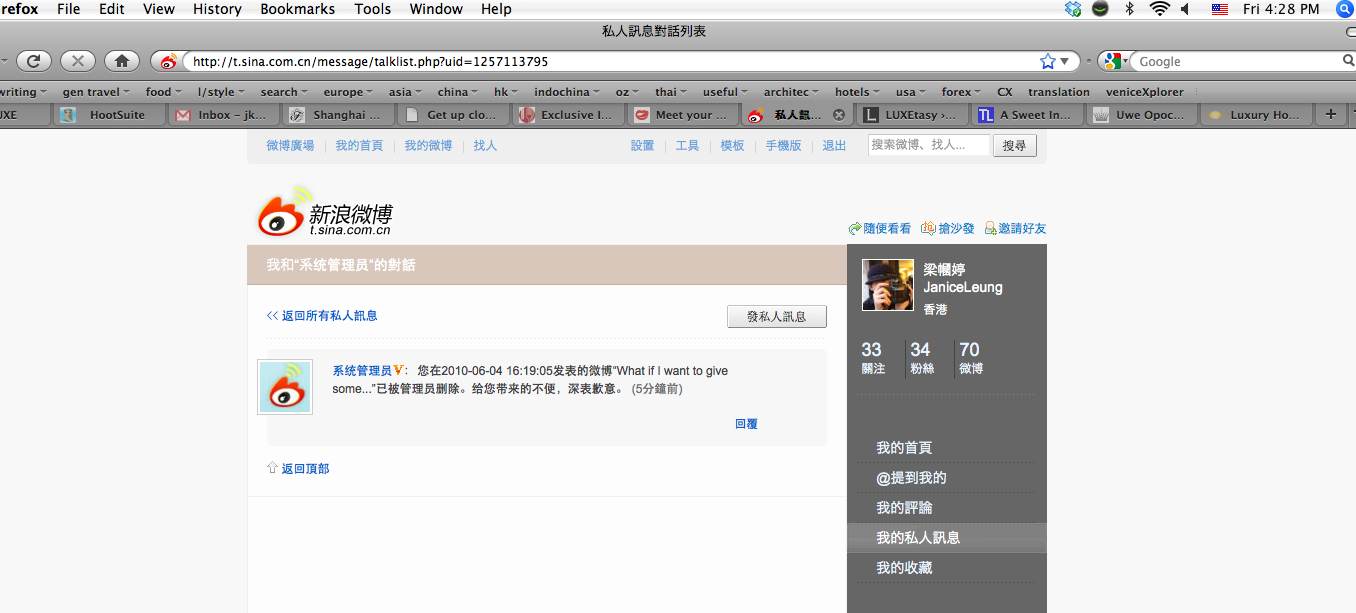
To be 河蟹-ed in social media means to have your post on Sina Weibo (China's own version of Twitter), or similar, deleted by admin, probably because the message touched upon 'sensitive' issues like the June 4 Tian'anmen incident in 1989, like mine.

Soon after I tweeted, I got a direct message from 系统管理员:

您在2010-06-04 16:19:05发表的微博“What if I want to give some...”已被管理员删除。给您带来的不便,深表歉意。

My 'tweet' was actually a retweet of someone else who said remarked that the candle and flower icons/emoticons (used like smileys) we unavailable today, and I added, "what if I want to give someone a flower today?"

That was all it took.

So remind me, how is China the world's next superpower?

Tuesday, 11 May 2010

Is the Chinese language going to take over the world?


I came across this article in More Intelligent Life, the Economist's 'Lifestyle' arm, entitled "Should you teach your kids Chinese?". The article in fact addresses a much more specialised question - "In light of "China's rise", will Chinese become the world's lingua franca, and hence, should you jump a step ahead and make sure your kids learn it to get an advantage over everyone else?"

The writer, Robert Lane Greene, an international correspondent for the Economist, basically says no, because it's unlikely that Putonghua will become the world's lingua franca, mainly because of its complicated writing system (characters that even native speakers take years to master).

I agree with the first bit, that it's unlikely that Standard Chinese (or Putonghua, Mandarin - call it what you will) will become the world's lingua franca. I just didn't like the way he says it - "America’s superpower status has made it everyone’s favourite second language." Dude, the world does not revolve around America. The proliferation of English has the British Council to thank too. If we only learnt English through American media we'd all be speaking like the sex-up sluts in B-grade Hollywood movies.

Americans and Euro/Anglo-centric writers and journalists, stop talking like you are the centre of the universe. Firstly I doubt the universe, or our globe at least, really has a centre of 'power', and secondly, just because you got rich more quickly (partly because you went and colonised resource-rich Asian and African nations), it doesn't mean your theories are going to work globally, all the time, or that you should impose your values on us.

Anyway, I digress. Parents have all sorts of reasons for wanting their kids to learn particular languages, arts or skills, and as the principal carer of the child, it's their choice. I agree with Greene that it shouldn't be solely because China is "rising" (by the way, you should think again when you blurt that out at another Manhattan dinner party, and here's one reason why). If you love Chinese culture, or think you'll move there, or that your kid will, then yeah, by all means, go for it, but these are the same reasons why you should be sending your kid to Spanish classes, Taekwondo practice or choir.

As for the Chinese-is-too-difficult-to-write argument, well all I can say is, Arabic looks pretty damned hard too.

Thursday, 1 April 2010

Pop will save us

Yesterday Hong Kong singer/actress Gigi Leung showed her support for parents affected by the melamine milk scandal in China by posting a message on her Weibo (micro blog - Sina, i.e. China's own Twitter).

She was soon told by Sina admin to delete the message.

She did, and soon after, she posted:

《墨菲定律》很有趣:别跟傻瓜吵架,不然旁人会搞不清楚,到底谁是傻瓜?
Murphy's Law is so interesting, it says: Don't quarrel with an imbecile, else people might get confused as to who the idiot is.*

内地有内地的规矩...好,我删!但不公平的事还是不想再看到...尤其发生在平民百姓身上。
The mainland has its own rules. Fine, I deleted it! But I really don't want to see such injustice, particularly to the average person.*

Screenshot from her Weibo page

Hong Kongers are notorious for being apolitical, but also extremely susceptible to messages in mass media. Given the extremely low levels of media literacy, messages from pop stars are usually well-received. (Look at all the celebrity endorsed diet ads...)

Already there are people coming out to say how much they admire Gigi because of this incident. So will her little run-in help drill into HKer's heads that China's prevention of free speech could one day be imposed on us?


To read more:

Story from Apple Daily here and here (in Cantonese).


Some blogger/forum commentary:
(so far all in Chinese)...

MO's notebook 3 to 4
鹿米館
阿休 Blog
she.com forums

*my very rough translations - couldn't find the original for that Murphy's Law!

Thursday, 12 November 2009

O, great motherland of China, we all love you

Is that sufficient to keep the propaganda committee away from me?

You know, it's been almost 13 years since the handover, and most of Hong Kong has gone from fearing the mainland to trying to to everything they can to please them/it. Why? Well, Hong Kong is all about the money, and this 1.4 billion market just north of us is just too good to resist. Hong Kongers are doing everything to wrangle their way into the market. Some do nice things like build schools, others fund government official's kids' Ivy League educations, and some do nothing. But even the last group wouldn't go out of their way to criticise the Motherland. No, no, that would be fatal.

Mainland leaders aren't the smartest, but they've managed to produce soft propaganda to have HK by the nose. How? Making it easier for HK businessmen to go into China to set up businesses, letting the floodgates open for the nouveau super riche to come and treat Hong Kong like a giant shopping mall... It's all money, honey.

The philosophy behind this is that as long as HK is fairly prosperous, no one will complain about their rapidly diminishing rights. Who needs rights when you can live comfortably in your 5,000 sq ft apartment on the Peak? Well, that's if your electronics factory hasn't been closed down because you let someone else pay for your local official's new car. Censorship? What's that? Just shut up and eat your abalone.